
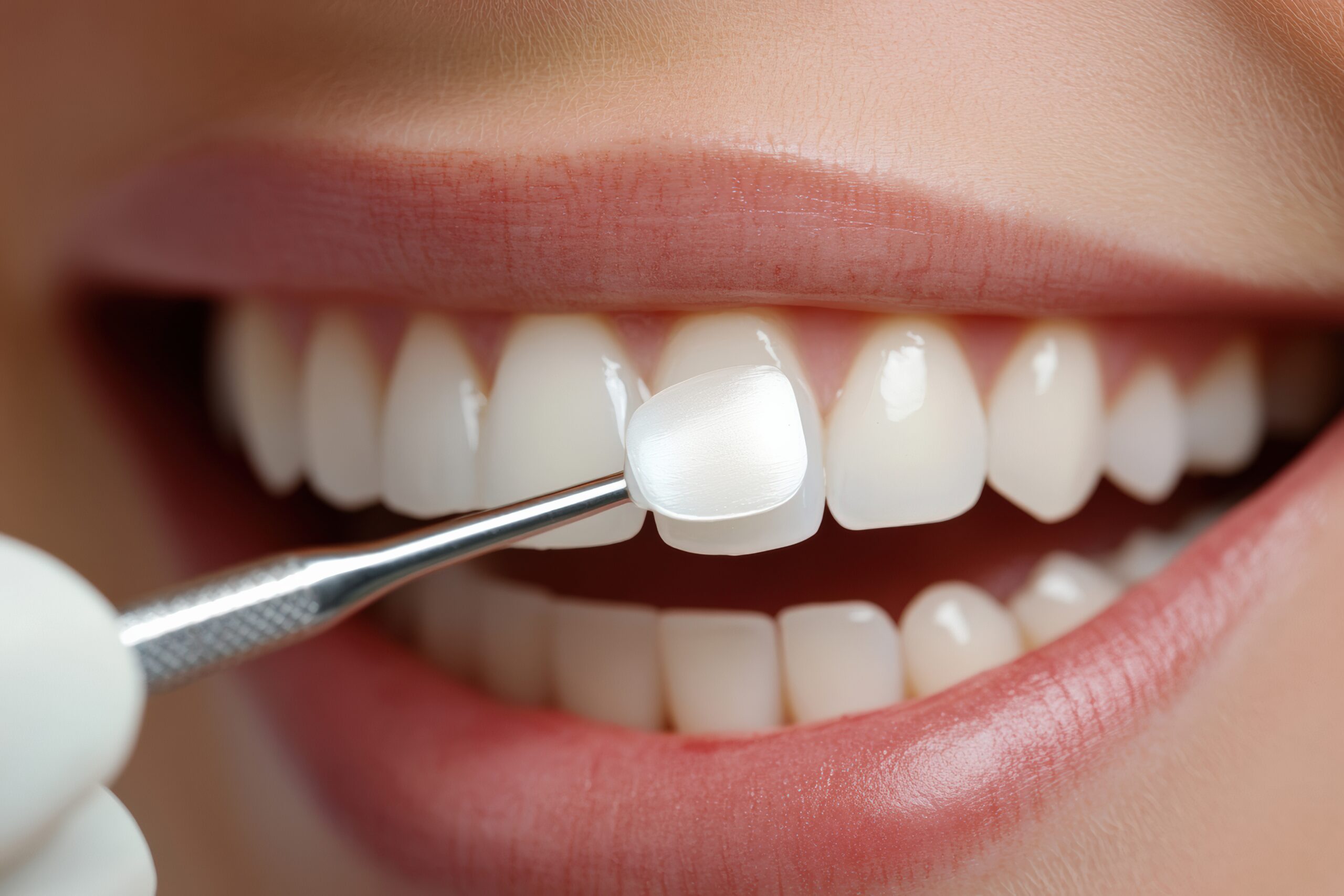
What patients really want to know – and how to make an informed decision
Anyone considering veneers usually has more than just an aesthetic goal in mind – they also have many questions.
“What happens to my natural teeth?”, “Is it permanent?” or “Will people be able to tell they’re not real?”
In this article, we address the most common concerns patients have – clearly, objectively, and based on dental expertise.
What are veneers – and when are they useful?
Veneers are ultra-thin shells – usually made of ceramic – that are permanently bonded to the visible front surface of the teeth.
They are recommended when teeth are:
- discoloured and can no longer be whitened
- uneven in shape or have small defects (e.g. a chipped edge)
- slightly misaligned or show visible gaps
The goal is a more harmonious, even smile without fully crowning the tooth. As much natural tooth structure as possible is preserved.
🙋♀️ Concern 1: “Don’t teeth have to be ground down a lot for veneers?”
Many patients fear that their teeth will be heavily damaged or filed down for veneers.
The answer: No – not anymore.
With modern veneer techniques, only a minimal amount of tooth structure is removed – often less than half a millimetre. In certain cases, for example when teeth are ideally positioned, non-prep veneers are even possible, meaning veneers without any grinding.
✅ IMPORTANT: An experienced dentist will decide whether preparation is needed and how much – based entirely on your individual dental situation.
🙋♀️ Concern 2: “Veneers look fake!”
This is a very common misconception.
In fact, the opposite is true – when they are done well.
Modern ceramic veneers are translucent, allow light to pass through, and are individually customised in colour, shape and surface texture. High-quality veneers do not stand out – they look like natural, healthy teeth.
✅ IMPORTANT: Veneers are not standard products. They are custom-made and tailored to your face, bite and natural tooth colour.
🙋♀️ Concern 3: “Does the treatment hurt?”
Veneer treatment is generally painless. If preparation is required, it is performed under local anaesthesia. After placement, your teeth may be slightly sensitive to temperature for a few days – this usually subsides on its own.
🙋♀️ Concern 4: “How much does it cost – and does insurance cover it?”
The cost per veneer depends on the country, clinic, technique and materials used.
Public health insurance does not cover veneers, as they are considered an aesthetic treatment.
Private or supplementary dental insurance may reimburse part of the cost under certain conditions, depending on the policy.
🙋♀️ Concern 5: “Don’t veneers break, fall off or wear out quickly?”
Well-made veneers usually last 10 to 15 years – often longer with good care.
Key factors for longevity:
- good oral hygiene (dental floss is essential)
- regular professional dental cleanings
- protection in cases of teeth grinding (e.g. a night guard)
- avoiding excessive mechanical stress (e.g. cracking nuts with front teeth)
✅ IMPORTANT: If a veneer does come off, it can usually be reattached or replaced.
🙋♀️ Concern 6: “Are there risks with veneers?”
As with any dental treatment, there are some risks – but they are rare when planning and execution are done properly:
- temporary tooth sensitivity
- irritation or overhangs if the fit is inaccurate
- fractures or chipping under excessive pressure
- gum recession with poor oral hygiene
✅ IMPORTANT: An experienced dentist will inform you thoroughly and carefully assess whether veneers are suitable for you at all.
🙋♀️ Concern 7: “What if I want my natural teeth back later?”
Once teeth have been prepared, they cannot simply return to their original state.
This means that veneers are a permanent solution and will need to be renewed periodically (every 10–15 years, often longer with good care).
✅ IMPORTANT: Veneers are not reversible – which is why a well-informed decision and thorough consultation beforehand are essential.
Veneers are safe – when properly planned
Most concerns about veneers stem from outdated or unreliable information. The best approach is to consult a dentist you trust, have a thorough examination, and get everything explained in detail.
From a medical perspective, veneers today are a tooth-conserving, durable and highly aesthetic solution for improving a smile – provided they are carefully planned, medically supervised and professionally executed, as we do.
If you’re unsure whether veneers are right for you, an initial, no-obligation consultation is well worth it. What matters is not only what is possible, but what truly makes sense for you – and that’s exactly what we discuss individually.