
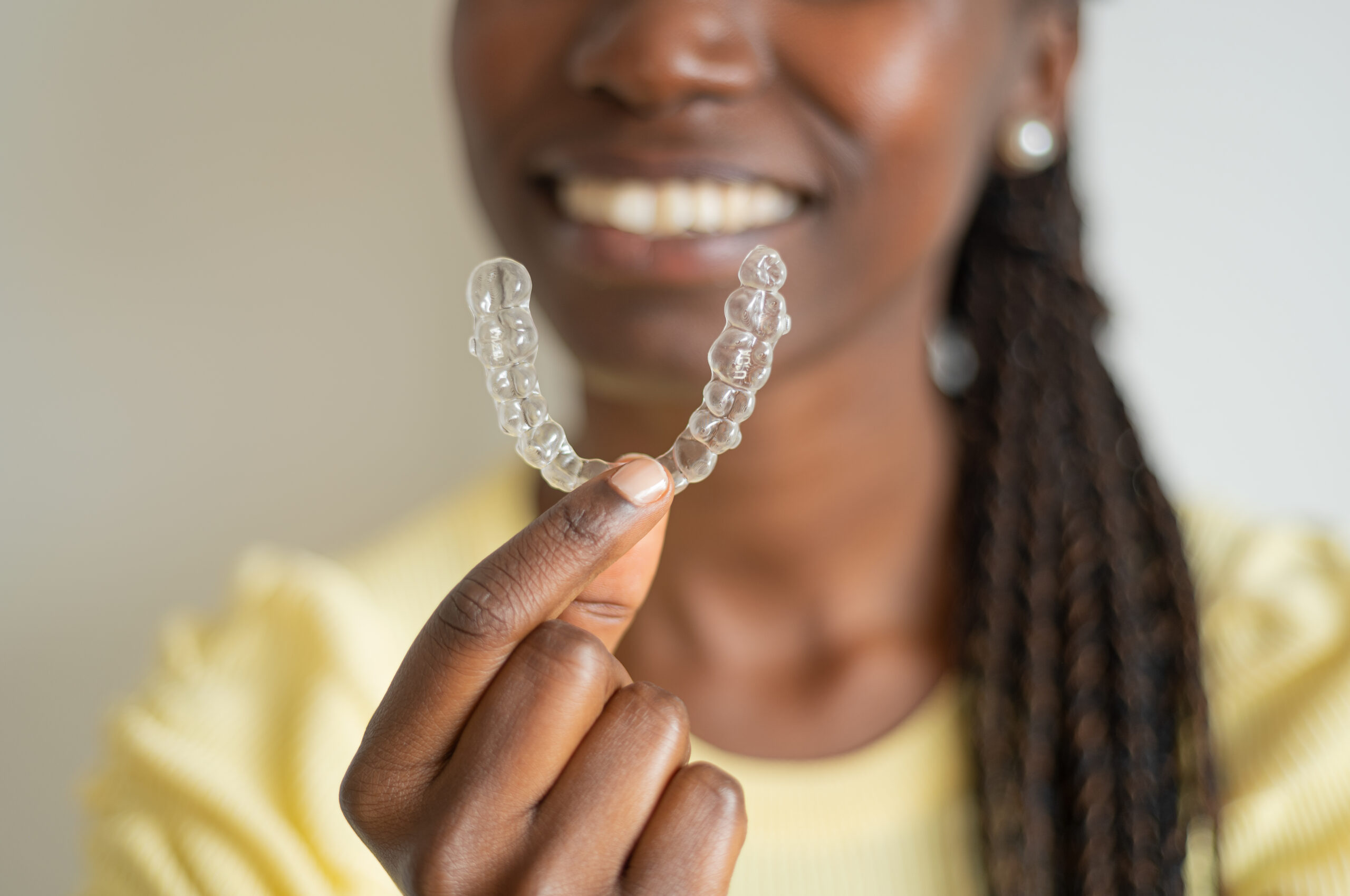
Aligners are transparent, custom-made dental trays used for orthodontic correction of misaligned teeth.
The treatment is based on digital 3D planning, precise simulation of each individual tooth movement, and a sequence of aligners that are changed every 1–2 weeks. Each aligner moves the teeth in small, controlled steps of just a few tenths of a millimeter.
The principle is medically well defined. However, everyday life with aligners raises questions—questions people don’t always feel comfortable asking, but still want answered. Here are the five most interesting ones:
1. Do aligners affect kissing or oral intimacy?
Generally, no. Aligners are made of transparent, medical-grade plastic and fit snugly over the teeth. Unlike traditional braces, they have no metal components such as brackets or wires.
For intimate situations:
- The surface is smooth
- Attachments are covered by the aligner
- There is no increased risk of injury
Whether you keep them in or remove them briefly is a matter of comfort.
Medically, both options are fine—as long as you maintain a daily wear time of 20–22 hours.
The only important thing is proper hygiene before reinserting them.
2. Do aligners cause bad breath?
Aligners fully cover the tooth surfaces, creating a closed, moist environment. If food particles or bacterial plaque are not removed, bacteria can multiply.
This can lead to bad breath.
How to prevent bad breath while wearing aligners:
- Brush your teeth thoroughly after every meal
- Clean between your teeth daily with floss or interdental brushes
- Clean your tongue regularly
- Use fluoride toothpaste
- Rinse aligners with cold water every time you remove them
- Clean aligners daily with a soft toothbrush and mild cleanser
- Do not use toothpaste on aligners (it causes micro-scratches)
- Soak aligners daily in a cleaning solution or tablets
- Only drink water while wearing aligners
- Clean and dry the storage case regularly
- Do not use hot water
Consistent oral and aligner hygiene prevents biofilm, bad breath, and cavities during treatment.
3. Do you start drooling with aligners?
It can actually happen—especially at the beginning of treatment—that saliva production temporarily increases.
This is due to a natural protective mechanism. The mouth contains many sensitive receptors in the mucous membranes. When a new aligner is inserted, these receptors detect an unfamiliar mechanical stimulus.
Through a reflex in the nervous system, the salivary glands are activated. Saliva helps to:
- Moisten the oral tissues
- Reduce friction
- Wash away bacteria
- Help integrate the new “foreign object”
Medically, this is called an adaptive response—meaning the body adjusts to a new situation.
Once the tongue, lips, and cheek muscles get used to the aligner, the stimulus decreases, and saliva production returns to normal.
Typical duration: a few days, occasionally up to a week.
Persistent excessive saliva is uncommon with a properly fitted aligner.
4. Loose teeth from aligners – is that normal?
A slight feeling of tooth mobility is actually part of how the treatment works.
Aligners apply controlled, continuous forces to the supporting structures of the teeth (medically called the periodontium). This triggers a biological remodeling process:
- Bone is slightly broken down on the pressure side
- New bone forms on the opposite side
This is the only way teeth can move.
During this phase, teeth may feel slightly loose—especially in the first few days after switching to a new aligner.
Important:
This does not mean the tooth is unstable or being damaged. It’s actually a sign that the planned movement is happening.
Once bone remodeling is complete and the tissue stabilizes, the sensation decreases.
Severe, painful, or persistent looseness is not typical and should be checked.
Mild, temporary mobility, however, is a normal part of treatment.
5. Does my face change with aligners?
Clear aligners correct tooth position—not facial bones. The shape of your nose, forehead, or jawbone remains unchanged.
However, what can change is lip support.
Teeth act as an internal support structure for the face. They influence:
- The shape and fullness of the lips
- The width of your smile
- Tooth visibility when speaking
- Side profile harmony
When crowding is corrected or protruding/retruded teeth are adjusted, subtle changes in appearance can occur.
Examples:
- Lips may appear more balanced
- The smile may look more symmetrical
- A corrected front tooth position can improve facial profile
Important:
Aligner therapy does not cause dramatic facial changes. It optimizes tooth position functionally—with an aesthetic side benefit.
Do you have a question we haven’t answered here?
Even if it feels unusual – ask it.
Call us or schedule an appointment.
We take the time to address your concerns.